


Most Taiwanese do not subscribe to the “one China” policy, or the idea that Taiwan is part of China, a survey conducted by the Taiwan Cross-Strait Policy Association showed.
According to the survey, 59.7 percent of respondents said that president-elect Tsai Ing-wen (蔡英文) “should not state in her inauguration speech that both sides [of the Taiwan Strait] belong to ‘one China,’ while 22 percent said she should,” association secretary-general Anson Hung (洪耀南) told a news conference in Taipei.
“Asked if they think Tsai should give in if China openly threatens to reduce the number of Chinese tourists to Taiwan, 60.4 percent said they still believed that she should not say Taiwan and China are parts of ‘one China,’ while 24.7 percent said she should,” Hung said.
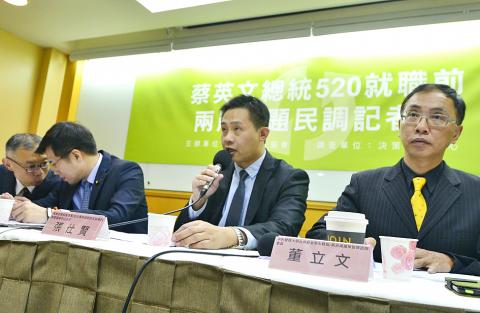
Photo: Wang Yi-sung, Taipei Times
Asked if Tsai should give in to the threat that China would suppress Taiwan’s international space, 60 percent of respondents said she should not; 57.2 percent also said she should not give in to Beijing’s threat of cutting cross-strait economic exchanges.
“The results of the survey show that, no matter how China pressures or threatens Taiwan, the majority of the public still do not agree with the idea that Taiwan and China belong to ‘one China,’” Hung said.
Democratic Progressive Party Legislator Lo Chih-cheng (羅致政) told the news conference that the results of the association’s survey are similar to those of other polls conducted by other organizations as well as the Mainland Affairs Council, and urged Beijing to review those results as well.
“Leaders of a democracy should act according to the will of the majority, and the poll shows that Beijing’s idea of ‘one China’ is unacceptable to most people in Taiwan, and it would be difficult for Tsai to go against the majority,” Lo said.
“Cross-strait relations can progress more smoothly if it remains ambiguous to a certain extent, so Beijing should not be so eager to break that ambiguity,” Lo said.
Chiu Chui-cheng (邱垂正), an associate professor at National Quemoy University’s Department of International and Mainland China Affairs, said that China often calls on Taiwan to respect the opinion of its 1.3 billion people, but “what qualification does the Chinese leadership have to make that call when it does not even respect the opinions of its people and restricts the freedom of speech?”
As Tsai insists that the core of her cross-strait policy is maintaining the “status quo” and refuses to recognize the so-called “1992 consensus,” Beijing has stepped up its calls for Tsai to abide by the “consensus,” while threatening that refusal to do so may lead to serious consequences in cross-strait exchanges.
Although Beijing did not confirm it, there have been rumors that a sharp decline in the number of Chinese tourists visiting Taiwan following Tsai’s election is a result of China’s protest over her cross-strait stance.
The poll, conducted from Monday to Wednesday, collected 1,072 valid samples. It has a confidence level of 95 percent and a margin of error of 2.99 percentage points.

‘NO SECURITY RISK’: The Railway Bureau reassured the public that the technicians’ activities were limited to technical guidance and did not involve sensitive systems The Railway Bureau yesterday said it had invited eight Chinese technicians to assist with an airport MRT construction project. The bureau issued the confirmation after an Internet user said Chinese nationals had entered the construction zone of Taiwan Taoyuan International Airport’s Terminal 3 project. They asked why “individuals from an enemy state” were allowed access to such a major national infrastructure project, which raised serious concerns over Taiwan’s industrial safety, sensitive systems and information security. The bureau’s Northern Region Engineering Branch Office said subcontractor Taiwan Handle Industrial Co (台灣手把工業) of the Taoyuan airport MRT’s “Contract No. CU05 Project A14 Station Civil, MEP &

A US uncrewed surface vessel (USV) encountered multiple Chinese warships during an autonomous transit of the Taiwan Strait, US defense company Seasats said in a statement on Wednesday. Seasats announced that a Lightfish USV had completed the first autonomous transit of the Taiwan Strait. Over five days, the USV traversed the entire length of the Strait while constantly monitoring surface vessel traffic, the company said. The Lightfish encountered multiple Chinese warships, one of which was a Chinese People’s Liberation Army Navy (PLAN) Type 056 corvette, it said. The Chinese vessels were operating “well within Taiwan’s exclusive economic zone without transmitting their identity via the
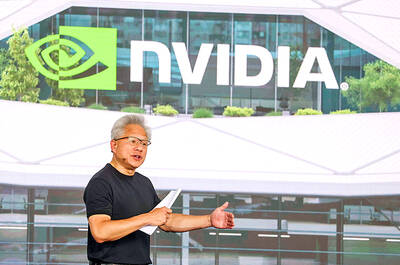
‘BOOMING’: ’ The number of partners we have here is incredible. You can see from their stock prices. They’re doing so well, they’re so happy,’ Jensen Huang said Nvidia Corp’s spending in Taiwan has ballooned to about US$150 billion a year, 10 times the US$10 billion to US$15 billion the company spent five years ago, Nvidia chief executive officer Jensen Huang (黃仁勳) said yesterday, suggesting Taiwan’s strategic importance in the global artificial intelligence (AI) supply chain. “Taiwan is the epicenter of the AI revolution. This is where the chips come, packaging comes. This is where the systems are made. This is where AI supercomputers were created,” Huang said at a meeting for the company’s employees in Beitou-Shilin Technology Park (北投士林科技園區) in Taipei, the planned site of Nvidia’s Taipei headquarters. “Taiwan
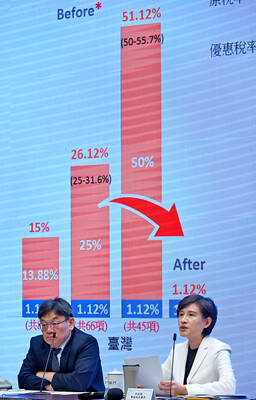
GREATER REACH? Auto parts and wood products would face tariffs of up to 15%, matching those targeting the EU, Japan and South Korea, Vice Premier said The US has announced that preferential tariff treatment for Taiwan’s non-semiconductor Section 232 goods would take effect retroactively from May 1, the Executive Yuan said yesterday. The US government yesterday posted a notice on the Federal Register’s public inspection Web site previewing tariff concessions for Taiwan under a memorandum of understanding (MOU) on Taiwan-US investment after two months of negotiations. The MOU signed on Jan. 15 stipulated three major preferential tariff arrangements: a 15 percent “reciprocal” tariff rate for Taiwan without stacking most-favored nation (MFN) rates; preferential Section 232 treatment for semiconductors and related products; and preferential Section 232 treatment for non-semiconductor


 RSS
RSS